Waterdrop G3P800 Review: 800 GPD Tankless RO With UV, Specs and Costs
The Waterdrop G3P800 is the top model in Waterdrop's G3 tankless reverse osmosis line. It shares the housing of the G3P600 but adds a UV stage, higher rated output (800 gallons per day) and a more efficient 3:1 pure-to-drain ratio. It is certified to NSF/ANSI 58 by IAPMO R&T, with the broadest certified reduction list in the G3 family. It makes sense for large households or kitchens with heavy daily use. For most homes, the G3P600 delivers the same experience for less money.
One practical note before anything else: as of October 2026, Waterdrop's US store lists only a refurbished G3P800, and it is sold out. New units are sold on Amazon.
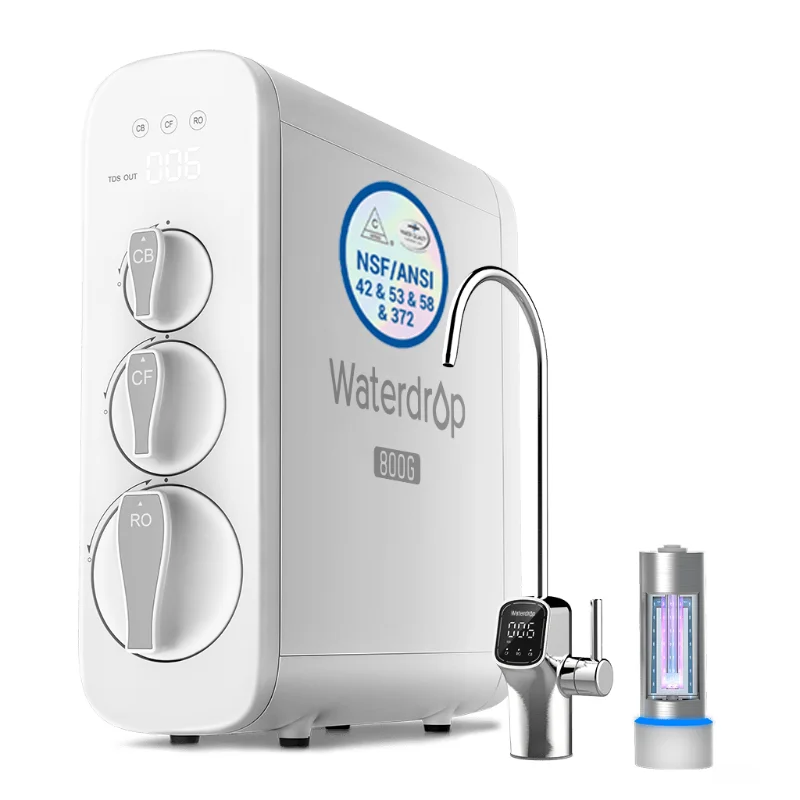
Published specs
| Spec | Waterdrop G3P800 |
|---|---|
| Type | Tankless under-sink RO with UV |
| Rated output | 800 GPD (about one 6 oz cup in 5 seconds, per Waterdrop) |
| Pure-to-drain ratio | 3:1 |
| Filtration | CF, CB and RO cartridges plus UV, marketed as 10 stages |
| Certification | NSF/ANSI 58 by IAPMO R&T (file WC-13976); Waterdrop also states NSF/ANSI 42, 53 and 372 |
| Faucet | Smart faucet with real-time TDS and filter status |
| Power | Required |
| Dimensions | 18.11 × 5.67 × 17.73 in |
| Weight | 32.4 lb |
| Warranty | 1 year |
Sources: Waterdrop product pages and the IAPMO R&T certificate of listing, October 2026.
What the G3P800 adds over the G3P600
Higher output
At 800 GPD, the G3P800 is rated about a third faster than the G3P600. In practice, both fill a glass in seconds. The difference shows up when you fill large pots, several bottles in a row, or a refrigerator or ice-maker line connected to the same system.
Better water efficiency
Its 3:1 pure-to-drain ratio sends about one gallon to the drain for every three gallons of purified water, against one for every two on the G3P600. If you use a lot of RO water, or live where water is metered and expensive, that adds up over the years.
UV stage
A UV light after the membrane targets bacteria and viruses before water reaches the faucet. On city water that is already disinfected, it is an extra layer rather than a necessity. It matters more if your storage or plumbing conditions concern you.
Broader certified reductions
Both models are on the same IAPMO R&T certificate for NSF/ANSI 58 (file WC-13976). The G3P600 is certified for TDS, fluoride, cadmium, hexavalent chromium and selenium. The G3P800 adds barium and radium 226/228. If a water report flagged radium, which is more common in some groundwater sources, that difference is relevant.
Like the G3P600, Waterdrop's marketing for the G3P800 lists more than the certificate covers, including NSF/ANSI 42, 53 and 372. Treat anything not on the certificate as a manufacturer statement. You can confirm the listing in the IAPMO R&T product listing directory under file WC-13976.
Drawbacks to weigh
- Availability. Waterdrop's own US store doesn't currently sell it new. Buy from a source with a clear return policy and confirm the listing is a new unit, not refurbished.
- It needs power. The pump and UV both need an outlet under or near the sink.
- No minerals. Like any RO system, it removes calcium and magnesium. A remineralization add-on costs extra.
- More capacity than most homes need. A household of one to five people rarely uses more than the G3P600 provides.
- One-year warranty.
Filter costs
Waterdrop specifies:
| Cartridge | Interval | Waterdrop list price |
|---|---|---|
| CF pre-filter (WD-G3-N1CF) | 6 months or 550 gallons | about US$30 |
| CB carbon filter (WD-G3-N3CB) | 12 months or 1,100 gallons | about US$30 |
| RO membrane (G3P800) | 24 months | check current price |
Waterdrop sells a one-year combo for the G3P800 at around US$90. The CF and CB alone come to roughly US$90 a year at list prices. On top of that, plan for an RO membrane every two years. High-TDS or sediment-heavy water shortens every interval. See our Waterdrop filter replacement guide for part numbers and intervals.
G3P800 or G3P600?
| G3P600 | G3P800 | |
|---|---|---|
| Output | 600 GPD | 800 GPD |
| Pure-to-drain | 2:1 | 3:1 |
| UV stage | No | Yes |
| Certified reductions (NSF/ANSI 58) | TDS, fluoride, cadmium, Cr-6, selenium | Same, plus barium and radium 226/228 |
| Where to buy new (US) | Waterdrop and retailers | Amazon |
Choose the G3P800 if you have a large household, connect a fridge or ice maker to the same system, want a UV stage, or your water report flagged radium or barium.
Choose the G3P600 if you have an ordinary household on city water and want to spend less. See our Waterdrop G3P600 review.
Who should skip both
- No outlet under the sink: a tank-based RO system needs no power.
- Well water with iron, sulfur or sediment: treat it at the point of entry first. Start with well water testing.
- Whole-house problems: hardness or sediment throughout the house is a point-of-entry job, not a sink-level one.
Installation
The installation is the same as the G3P600's: a cold-water feed, a drain saddle, a faucet hole and an outlet. Our under-sink RO installation guide covers each step.
Bottom line
The G3P800 is the stronger machine: more output, better efficiency, UV and a broader certified reduction list. For most households, though, the G3P600 covers what matters for less money. Pick the G3P800 when capacity, UV or radium/barium reduction are real requirements, and buy it new from a source with a clear return policy.
Strengths
- 800 GPD output, about 6 oz in 5 seconds per Waterdrop, which is the fastest in the G3 line.
- 3:1 pure-to-drain ratio, more efficient than the G3P600's 2:1.
- Built-in UV stage after the membrane, which the G3P600 does not have.
- The broadest certified reduction list in the G3 family: TDS, fluoride, cadmium, hexavalent chromium, selenium, barium and radium 226/228.
- Same compact tankless footprint and twist-off cartridges as the G3P600.
Limitations
- Waterdrop's US store currently lists only a refurbished, sold-out unit; new units are sold through Amazon.
- Needs an electrical outlet for the pump and UV.
- No remineralization stage in the base model.
- Its 800 GPD capacity is more than most households of one to five people will use.
- 1-year warranty.