Waterdrop G3P600 Review: Specs, 5-Year Cost and Who It Fits
The Waterdrop G3P600 is a tankless under-sink reverse osmosis system rated at 600 gallons per day, with a 2:1 pure-to-drain ratio and a smart faucet that shows TDS and filter life. It is certified to NSF/ANSI 58, the reverse osmosis standard, by IAPMO R&T. It fits households on city water that want fast RO output without a storage tank taking over the cabinet. It is the wrong pick if there is no outlet under the sink, or if you want mineralized water without paying for an add-on.
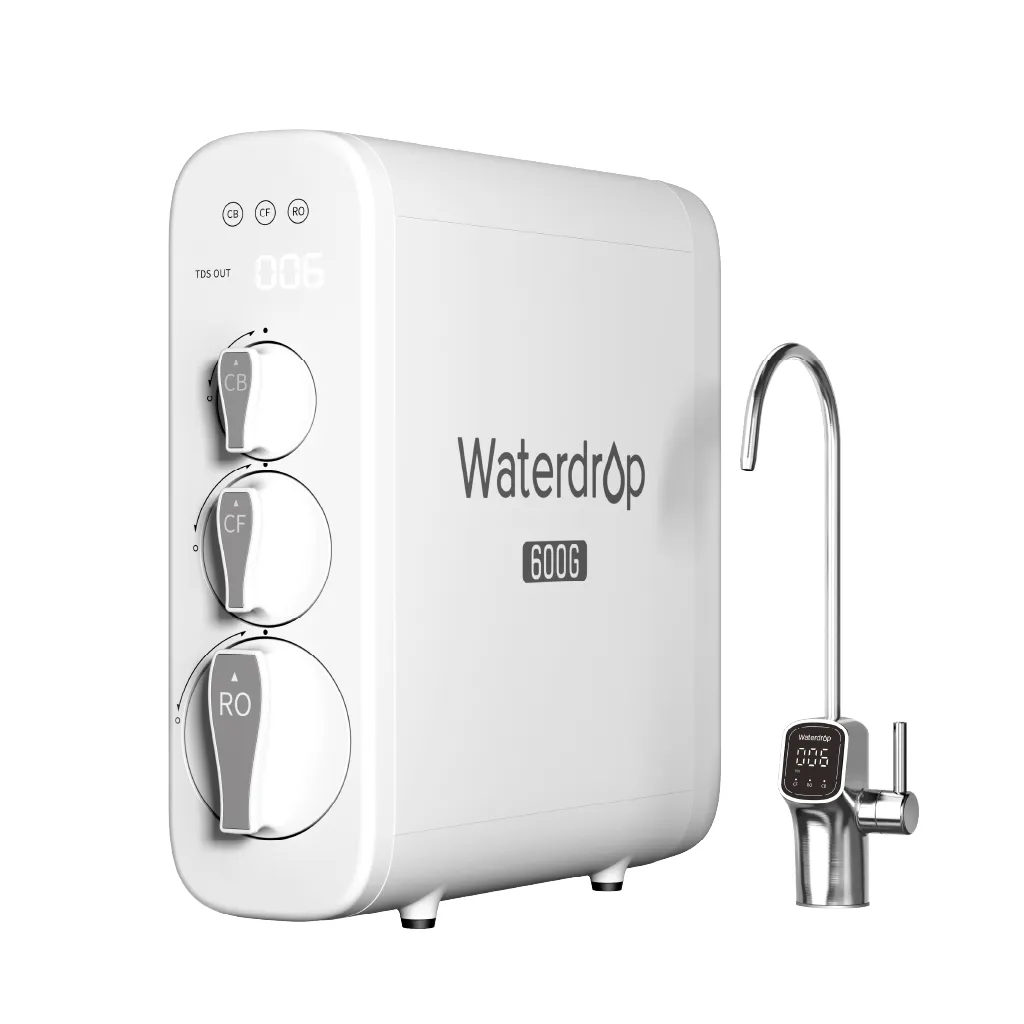
Published specs
| Spec | Waterdrop G3P600 |
|---|---|
| Type | Tankless under-sink RO |
| Rated output | 600 GPD (about one 8 oz cup in 8 seconds, per Waterdrop) |
| Pure-to-drain ratio | 2:1 |
| Cartridges | 3 (CF, CB, RO), marketed as 8 filtration stages |
| RO membrane | 0.0001 µm |
| Certification | NSF/ANSI 58 by IAPMO R&T (file WC-13976); Waterdrop also states NSF/ANSI 42 and 372 |
| Faucet | Smart faucet with TDS readout and filter-life indicator |
| Power | Plug-in adapter (included) |
| Dimensions | 18.11 × 5.67 × 17.73 in |
| Weight | 32.4 lb |
| Warranty | 1 year |
Source: Waterdrop's US product page, October 2026. Manufacturers revise models and bundles, so confirm on the product page before you buy.
What the design gets right
Fast output with no tank to refill
A traditional RO system fills a pressurized tank slowly and then delivers a few gallons before you have to wait again. The G3P600 uses an internal booster pump and sends water from the membrane straight to the faucet. For a household that cooks with filtered water or fills bottles and pitchers every day, that is the main reason to buy a 600 GPD tankless unit instead of a 50–75 GPD tank system.
Less water down the drain
Older under-sink RO systems commonly send three or four gallons to the drain for every gallon of purified water. At 2:1, the G3P600 sends about one gallon to the drain for every two it produces. That keeps the extra cost on your water bill low and makes RO easier to justify in drought-prone areas.
Compact under the sink
Without a tank, the whole system is a single box of about 18 × 6 × 18 inches. Waterdrop says that saves about 70% of the space a tank system takes, which usually leaves room for a trash pull-out or cleaning supplies.
Filter changes without tools
All three cartridges twist out from the front of the unit, with no housing wrench and no draining a canister. Combined with the faucet's filter-life indicator, maintenance is something most owners do themselves.
What the certification covers
The G3P600 (model WD-G3P600, replacement membrane WD-G3P600-RO) is certified to NSF/ANSI 58 by IAPMO R&T, an ANSI-accredited certification body, under file WC-13976. The certified reduction claims are TDS, fluoride, cadmium, hexavalent chromium and selenium. The CF and CB cartridges are certified for material safety and structural integrity when used in the system.
Two points before you compare it with other systems:
- It isn't in NSF International's own database. The standard is NSF/ANSI 58, but the certifier is IAPMO, so you won't find the model at info.nsf.org. That's normal and doesn't weaken the certification. Look it up in the IAPMO R&T product listing directory under file WC-13976.
- Waterdrop's marketing lists more than the certificate does. Lead, arsenic, PFOA/PFOS, chlorine and microplastics are in Waterdrop's copy but are not reduction claims on the NSF/ANSI 58 certificate. Waterdrop also states NSF/ANSI 42 and 372 certification, which is not on that same certificate. Treat those claims as manufacturer statements, not certified results.
Drawbacks to weigh
- It needs power. The booster pump runs on an outlet. If there isn't one under the sink, budget for an electrician, or consider a tank-based RO system that doesn't need power.
- No minerals in the base model. RO removes calcium and magnesium along with contaminants. If you prefer mineralized water, Waterdrop sells the G3P600 in bundles with a remineralization filter, at a higher price.
- The RO membrane is the expensive cartridge. The pre-filter and carbon filter are inexpensive. The RO cartridge costs about as much as both together and is replaced every two years.
- Pump noise. Owner video reviews mention the pump is audible while it runs, which is typical of tankless RO.
- Short warranty. One year. Factor that in if you plan to keep the system a long time.
- One faucet, not the whole house. For hardness, iron or sediment across the house, look at point-of-entry options instead.
5-year cost of ownership
Waterdrop specifies the CF pre-filter every 6 months, the CB carbon filter every 12 months and the RO membrane every 24 months. It estimates the average annual filter cost at around US$145.
| Item | Estimated range |
|---|---|
| System, one-time | US$400–US$540 |
| Filters over 5 years (about US$130–US$160 a year) | US$650–US$800 |
| 5-year total | US$1,050–US$1,340 |
That works out to roughly US$17–US$22 a month for RO water at the faucet. High-TDS or sediment-heavy water shortens cartridge life and pushes the number up. Multi-filter bundles and promotions bring it down. See our Waterdrop filter replacement guide for part numbers and intervals.
G3P600 or G3P800?
The G3P800 is in the same G3 family, with a higher rated output (800 GPD) and a higher price. For most households of one to five people, 600 GPD is already more capacity than they will use. The G3P800 makes more sense for large families, or for a kitchen where the same line also feeds a refrigerator or ice maker.
Who should buy it
A good fit if you:
- Are on city water and want RO-quality drinking water from a dedicated faucet
- Want fast output, no storage tank and a compact cabinet footprint
- Want to change filters yourself without tools
- Have, or can add, an outlet under the sink
Look elsewhere if you:
- Have no power under the sink and don't want to add it. A tank-based RO system fits better.
- Have well water with iron, sulfur or heavy sediment. Treat it at the point of entry first; well water testing is the place to start.
- Want mineralized water without an add-on.
- Need one system to treat the whole house.
Installation
Waterdrop markets the G3P600 as a DIY install of about 30 minutes. The steps are the same as for any under-sink RO system: tap the cold-water supply, fit a drain saddle, mount the faucet (drilling may be needed on stone countertops) and plug in the pump. Our under-sink reverse osmosis installation guide walks through each step.
Bottom line
On published specs, the G3P600 is one of the more practical under-sink RO systems in its price range: tankless, 600 GPD, 2:1 efficiency and tool-free filter changes. Before you buy, check two things: whether you have an outlet under the sink, and whether you're comfortable with RO water without minerals or willing to pay for the add-on.
Strengths
- Tankless 600 GPD design fills a cup in seconds, with no wait for a storage tank to refill.
- 2:1 pure-to-drain ratio wastes far less water than older 3:1 or 4:1 under-sink RO systems.
- Single compact unit frees most of the under-sink space a tank system takes.
- Twist-off cartridges and a faucet that shows TDS and filter life make maintenance a DIY job.
Limitations
- Needs an electrical outlet under or near the sink for the booster pump.
- Base model has no remineralization stage; mineral add-ons cost extra.
- The pump is audible while it runs, which owner video reviews mention.
- Warranty is 1 year.
- Treats one faucet only, not a whole-house solution.